Pay My Bill
 Call: (203) 869-1145
 Online Scheduling
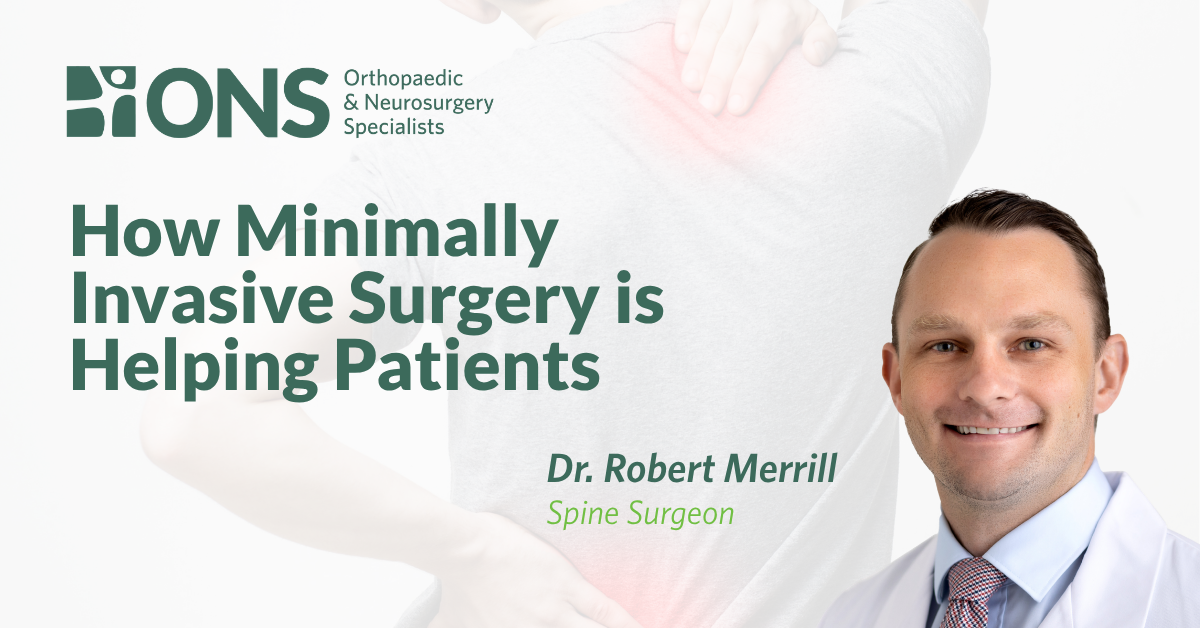
A Q&A with Dr. Robert Merrill, ONS Spine Surgeon, about the impact that minimally invasive approaches in spine surgery have on treatment and recovery.

Featured Doctor
Robert Merrill, MD
Robert Merrill, MD, is a fellowship-trained orthopedic spine surgeon at Orthopaedic & Neurosurgery Specialists.
View Profile
What is minimally invasive surgery (MIS) for the spine, and how is it different from open surgery?
MIS for the spine uses advanced techniques and technologies to accomplish the same objectives as traditional open surgery, but is often performed through smaller incisions with much less damage to soft tissues and other structures in the spine.
How does MIS benefit the patient?
Minimally invasive techniques typically offer patients:
- reduced postoperative pain
- lower infection risk
- faster recovery
MIS patients are often in the hospital for a shorter duration and return to work earlier when compared to those who receive open surgery. Because they often experience less postoperative pain, patients also generally take fewer narcotic medications.
What are some examples of MIS for the spine?
A major example that I often employ in my practice is the use of tubular retractors. A tubular retractor is a small tube that dilates muscle fibers instead of cutting through them. I use an operating microscope to look down the tubular retractor to see where I am operating. Many procedures are done through a tubular retractor that is just 19mm in diameter, which allows me to operate through much smaller incisions with less soft tissue damage. Several different surgeries can be done through a tubular retractor, such as a lumbar microdiscectomy, lumbar laminectomy, lumbar fusion, cervical foraminotomy.
Another similar example is endoscopic spine surgery, which utilizes a camera instead of a tubular retractor and microscope to accomplish a similar objective.
Additionally, our approach to the patient’s problem can be minimally invasive. Spine problems are often treated with an open posterior lumbar fusion done from the back of the spine. But in many scenarios, a lateral or anterior approach to the lumbar spine can be a more minimally invasive alternative.
What conditions do you treat with minimally invasive techniques?
Almost any condition can be treated in a minimally invasive way. The most common issues that I treat are lumbar disc herniations, lumbar stenosis, and lumbar spondylolisthesis. For patients with fractures that require surgery, I often employ minimally invasive robotic techniques to stabilize the fracture.
What role do technologies like imaging and robotics play in MIS for the spine?
Imaging and robotics play a pivotal role in MIS, because they enable us to safely place screws and implants through the skin via very small incisions. This allows us to be very accurate and precise with implant placement, while preserving a significant amount of soft tissue and musculature. Robotics and navigation have made this process much safer and more accurate.